



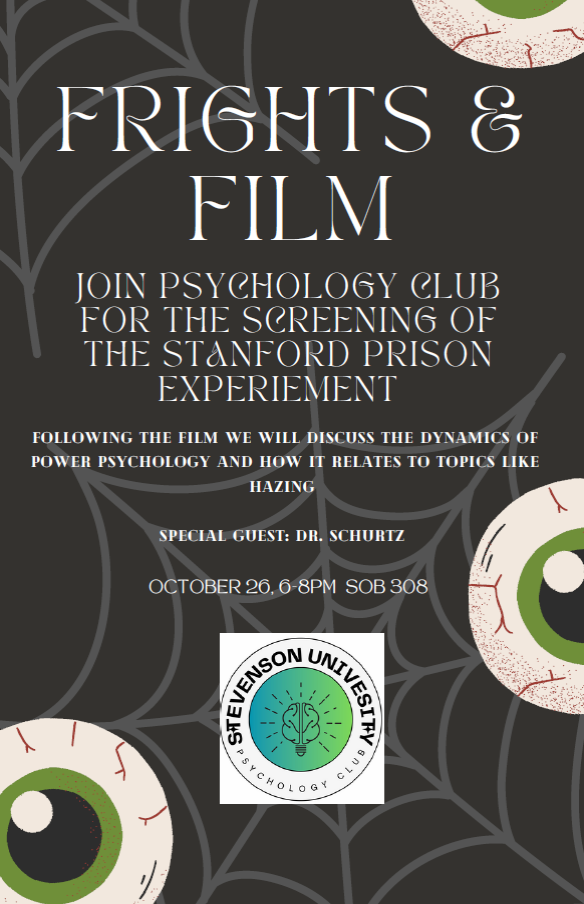
The moon is shining on a quiet, Thursday evening, and a group of students can be found in a dark classroom, mingling. In the spirit of Halloween, the Psychology Club held a screening of the Stanford Prison Experiment.
Stanford Experiment
The experiment, now considered unethical, was conducted in the 1970s by Philip Zimbardo and brought into question the pernicious effects of power and authority. A group of male Stanford students were tasked to run a mock prison and were each assigned a role: half were guards, and half were prisoners. Not far into the experiment, a trend progressively made itself apparent: guards became more aggressive, overexerting their power to the point of humiliating the prisoners, while the prisoners banded together and rebelled against the guards. As the abuse went on, the prisoners suffered psychological and emotional struggle, and many became submissive and despaired. This demonstration of the participants conforming to their role remains one of the defining aspects of the experiment.
As explained by Amy Franklin, an attendant of the film screening, there was conflict between the researchers as to whether they should stop the experiment. Some, particularly Zimbardo, was in favor of continuing. However, while the study was supposed to take one to two weeks, it prematurely ended after six days due to the deteriorating conditions of the prisoners. While the physical, emotional, and psychological effects were abdominable, they were not long term. Still, the contents of Zimbardo’s study remains relevant today and provides insight into topics such as mob behaviors, hazing, and conformity.
Discussion
After the film, special guest Dr. Ryan Schurtz led a discussion about the implications of the experiment, encouraging reflection about Zimbardo’s efforts. For one thing, there is debate about the end goal of the Stanford Prison Experiment. It is not clear what was measured, so it is thought the study was intended to be a simulation to advance knowledge in the field of social psychology. Even so, as discussed by the attendees of the screening, the simulation is inaccurate to the corrections system for a variety of reasons, one of them being the lack of structure that would protect prisoners from the magnitude of abuse they experienced under the experiment. Moral implications were also talked about by the attendants. Aside from the unsafe conditions the participants are placed under, they couldn’t leave on their own terms, and they weren’t properly debriefed afterwards. Even considering these flaws of the experiment, it can be agreed that Zimbardo’s contribution to psychology showcased how even unsuspecting people can be perpetrators of immoral acts.
Ultimately, the screening of the Stanford Prison Experiment held by the Psychology Club was well received by attendants and encouraged the contemplation of its ramifications in hazing and power psychology.