

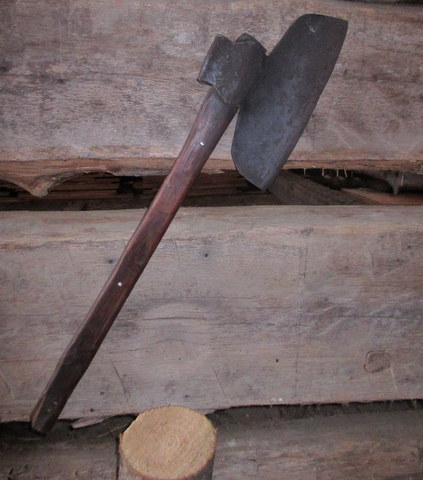
Broad Axe Used for Hewing Logs into Timbers
The Stevenson Public History Program undertook one of its best field trips in recent memory as it took to the roads to visit the Carroll County Farm Museum. On Saturday September 12th, a handful of intrepid PHIST majors and faculty members drove out to see Steam Day at the Carroll County Farm Museum. In addition to tractors, steam engines, and other paraphanalia organized by the Mason-Dixon Historical Society, the Farm Museum was showcasing its young oxen, new oxen “drivers,” and the blacksmith shop operated by the Blacksmith Guild of Central Maryland. Unfortunately, we were drenched throughout the day as the heavens randomly opened up and threatened to soak us to the skin.
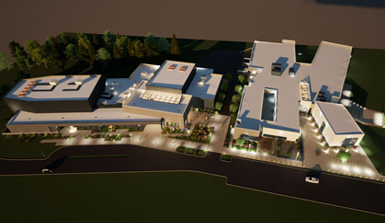
(Hoff Barn: Photo Courtesy of Carroll County Government)
The main purpose of our visiting the Farm Museum was to see the Hoff Memorial Barn. Built in the last decade of the 18th century, the barn was built as George Washington was midway through his time as President. A wonderful example a “Sweitzer” or “Swiss” barn, the Hoff barn has beautiful examples of hand hewn beams, timber joinery, and sympathetic preservation treatments throughout. Complementary displays of the type of tools that built the barn better help visitors understand the “v” notches they see on the ends of the timbers as well as the marks they observe on the hewn wood.
V-Notched Logs in Hoff Barn support the barn with no nails, spikes, or trunnels.
As we sought shelter from the downpour, the blacksmith’s shop beckoned us with its open doors. Inside we were warmly greeted by Ken Strosnider, of the Blacksmith Guild of Central Maryland, who treated us to the rare opportunity of seeing how a forge is lit, brought to a temperature to 3000 degrees F. using hand bellows, and a piece of metal worked from stock to finished product. Working with a variety hammers, tongs, and peens, Ken fashioned a piece of iron, gave it a brushed brass finish, and then finished it off by applying beeswax. What a great opportunity to learn from a patient blacksmith/public historian!
Ken Strosnider patiently works with both his piece of iron as he explains his craft to onlookers.
After leaving the blacksmith shop it was time to move on to other things. What better thing than to see the oxen plowing furrows at the farm? The relatively young oxen were working with two drivers recntly returned from an ox driving workshop at Sanborn Mills Farm in Loudon, NH. What rapidly became clear was the sheer difficulty of a new team of oxen and human drivers working together. My hat comes off in salute to those who showed how it is done!
Making a sidetrip to the former Carroll County alms house located at the Farm Museum, we learned of a special stone step upon which countless “hobos” had a free meal as they were passing through. According to Stefanie Stronsnider, museum curator, the itinerant wanderers were allowed one meal and an overnight at the alms house before being asked to move on. If they stayed, like the other longterm alms house residents, the hoboes would be asked to work for their room and board. There are two reminders that the alms house was once an important stop along the migratory hobo path. One is the worn stone where countless hoboes sat as they ate. The other is a collection of hobo art made largely from cigar boxes.
The worn stone where the hoboes ate their one free meal at the bbackdoor of the Carroll County Alms House.
We would like to thank the Carroll County Farm Museum for making us feel welcome on our daytrip, as well as the Blacksmith Guild of Central Maryland, and the Mason-Dixon Historical Society. Stefanie Strosnider is a consumate professional and did much to make our day a success. Thank you, Stefanie!!!
From L-R: Jamie Goodall, Andrea Marquez, Alex Boulton, Stefanie Strosnider, Glenn T Johnston, and Austin Knox.