




Protect Critical Systems and Fight Cybercrime
BACHELOR OF SCIENCE
Explore the Evolving Role of Artificial Intelligence
Cyber-attacks are rising every day, and governments and organizations need skilled cybersecurity professionals to protect critical digital systems. Stevenson University’s Cybersecurity and Digital Forensics program prepares you for a rewarding career investigating and combating cybercrime while exploring how artificial intelligence and other innovative technologies are transforming threat detection and response.
Our program is one of only 16 undergraduate programs in the nation to be designated a National Centers of Digital Forensics Academic Excellence (CDFAE) by the Department of Defense Cyber Crime Center (DC3). This designation recognizes a school that offers rigorous degree programs in information security to produce professionals capable of defending against the increasingly complex nature of cybercrime and intrusion in both government and industry.
Train with Professional Cybersecurity Tools
Develop the skills real cybersecurity and digital forensics professional use to collect, analyze, and create digital evidence reports on smartphones, computers, cloud services, and other devices. Practice using the same industry-standard digital forensics software and investigation tools used by governments, law enforcement agencies, and leading companies, including:
- Magnet Axiom
- EnCase
- FTK Imager
- Autopsy
- Volatility
- Wireshark
- Packet Tracer
- Metasploit
- Splunk
- Kali Linux
Certified for Immediate Impact
Graduates of our CDFAE-designated program receive two certificates of completion that can be exchanged for Department of Defense training course credit, allowing them to begin working immediately as recognized digital forensic practitioners.
Career Outcomes: Become a Cybersecurity Expert
Our unique program blends the instruction of a cybersecurity degree with the direct training of a digital forensics degree. Gain a deep understanding of cybersecurity policy and processes, learn how to identify and address security vulnerabilities, and become a successful leader in this vital field.
Want to go the extra mile? Our Bachelor’s to Master’s Option allows you to graduate with a master’s in as little as five years.
Graduates of the Cybersecurity and Digital Forensics program will:
- Develop a security policy for an organization that balances the organization’s mission, culture, human factors, and security requirements.
- Apply risk assessment methodologies in selecting and configuring security controls to protect information assets.
- Monitor a network infrastructure for cyber-attacks.
- Mitigate the effects on a network infrastructure due to a cyber-attack.
- Evaluate an end-to-end computer forensics investigation.
- Prepare a digital forensics evidence report.
Professional Roles:
- Ethical Hacker
- Cybersecurity Analyst
- Computer Forensics Analyst
- Threat Intelligence Analyst
- Information Security Analyst
- Digital Forensics Examiner
Stevenson’s Bachelor of Science (B.S.) in Cybersecurity and Digital Forensics and Master of Science (M.S.) in Cybersecurity and Digital Forensics have officially been designated a National Security Agency (NSA) Center of Academic Excellence in Cyber Defense (CAE-CD), a prestigious recognition that underscores the university’s commitment to cybersecurity education and workforce development.
Center for Cybersecurity
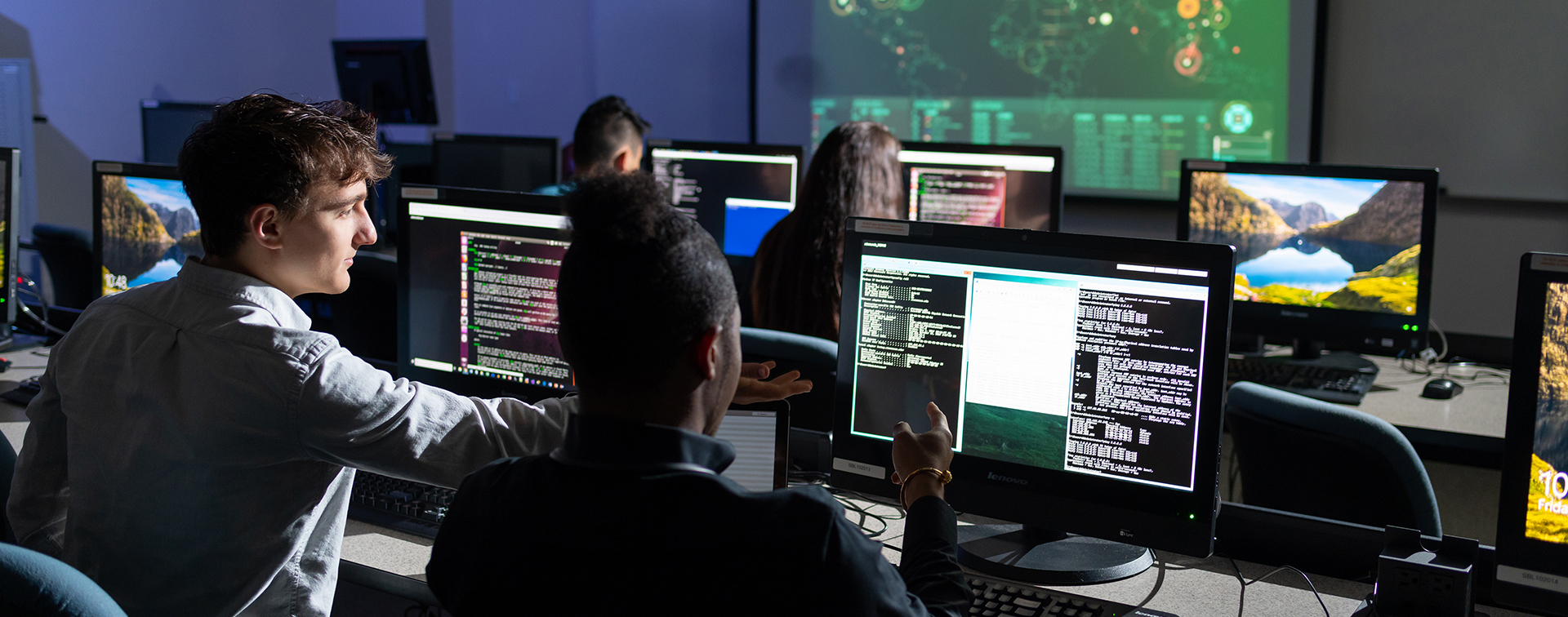
The Center for Cybersecurity at Stevenson provides a hands-on learning environment that fosters critical thinking, technical skills, and real-world problem-solving. Through interactive classes and collaborative projects with expert instructors, along with student led clubs, students gain the knowledge and experience necessary to tackle today’s cyber challenges.
Stevenson Cybersecurity and Digital Forensics
Career Connections
Internship Placements
- Accenture
- Exelon Corporation
- Johns Hopkins University Applied Physics Lab
- National Nuclear Security Administration
- Social Security Administration
- T. Rowe Price
- U.S. Secret Service
- U.S. Securities and Exchange Commission
Top Employers
- Central Intelligence Agency
- Deloitte
- Exelon Corporation
- Leidos
- Microsoft
- National Security Agency
- Northrop Grumman
- U.S. Department of Defense
Common Pathways
- Computer Forensic Investigator
- Computer Systems Analyst
- Digital Forensics Analyst
- Information Security Analyst
- IT Auditor
- IT Security Manager
- Malware Analyst
- Network Security Engineer
Bachelor’s to Master’s Option: Accelerate Your Master’s Degree
Get on the fast-track to your master’s degree with Stevenson’s Bachelor’s to Master’s Option. Start earning graduate credits while still an undergraduate and complete your Master’s in Cybersecurity and Digital Forensics in as little as one additional year.
Study Cybersecurity and Digital Forensics at Stevenson
Courses
The courses in the preview below are required for completion of the bachelor’s degree in Cybersecurity and Digital Forensics. Students must also complete the requirements for the Stevenson Educational Experience (SEE).
Course Preview
| CDF 110 | Cybersecurity and Digital Forensics Fundamentals | 3 credits |
| CDF 271 | Intrusion and Penetration Testing | 3 credits |
| CDF 290 | Legal Aspects of Cybersecurity | 3 credits |
| CDF 391 | Incident Response and Investigation | 3 credits |
| CDF 475 | Advanced Digital Forensics | 3 credits |
| IS 140 | Information Systems Architecture and Design | 3 credits |
| IS 432 | Network Security-Firewalls, IDS, and Counter Measures | 3 credits |
Academic Catalog
Explore our academic catalog for a full listing of courses, course descriptions, and suggested course sequence for Stevenson’s Cybersecurity and Digital Forensics program.
Major Requirements
| CDF 110 | Cybersecurity and Digital Forensics Fundamentals | 3 credits |
| CDF 240 | Linux System Administration | 3 credits |
| CDF 251 | Network Security | 3 credits |
| CDF 252 | Networking II | 3 credits |
| CDF 261 | Digital Forensics | 3 credits |
| CDF 271 | Intrusion and Penetration Testing | 3 credits |
| CDF 281 | Advanced Network Defense | 3 credits |
| CDF 290 | Legal Aspects of Cybersecurity | 3 credits |
| CDF 391 | Incident Response and Investigation | 3 credits |
| CDF 392 | Information Systems Forensic Internals – Auditing | 3 credits |
| CDF 393 | Forensic Evidence Collection Tools and Techniques | 3 credits |
| CDF 475 | Advanced Digital Forensics | 3 credits |
| CDF 480 | Cybersecurity and Digital Forensics Capstone | 3 credits |
| IS 140 | Information Systems Architecture and Design | 3 credits |
| IS 231 | Network Technologies | 3 credits |
| IS 232 | TCP and IP Communication Protocols for Windows and UNIX | 3 credits |
| IS 235 | Advanced Windows Server Architecture & Administration | 3 credits |
| IS 240 | Programming Concepts | 3 credits |
| IS 350 | IS Internship | 3 credits |
| IS 365 | Writing for IS Applications | 3 credits |
| IS 432 | Network Security-Firewalls, IDS, and Counter Measures | 3 credits |
| MGT 210 | Business Writing | 3 credits |
Complete all major requirements and take one course from ACC, FIN, INBUS, MGT, or MKT.
Minors and Other Options
Minor in Cybersecurity
The discipline minor in cybersecurity requires successful completion of a minimum of six courses and 18 credits of coursework required for the cybersecurity and digital forensics major. At least four courses must have a CDF course prefix indicator. General guidelines regarding minors may be found in the Minors section of the catalog.
Add a Professional Minor
Open yourself up to additional career paths with one of our professional minors. Each minor is designed to pair with students’ majors to give them additional career options, a competitive edge in the job market, and an opportunity to shape their Stevenson experience to meet their specific career goals.
Bachelor’s to Master’s Options
BS/MS options are available for students majoring in Cybersecurity and Digital Forensics who wish to combine their bachelor’s coursework while working toward a Stevenson University Master’s Degree in one of the following:
26%
According to the Bureau of Labor Statistics, job growth for information security analysts is projected to be 26 percent from now through 2026.
1 of 15
Our program is one of only 15 undergraduate programs in the nation to earn “The National Centers of Digital Forensics Academic Excellence” accreditation by Defense Cyber Crime Center (DC3).

Have a Question?
Contact Admissions
Undergraduate Admissions
Owings Mills Campus
Garrison Student Union
North Entrance, Second Floor
1-877-468-6852