


by Elizabeth Honbarrier
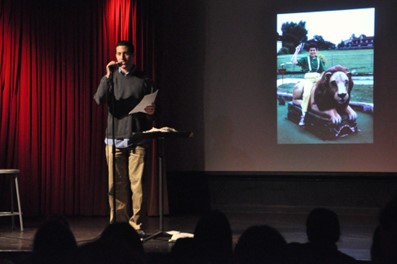
[Adam Ruben at Mortified, 92YTribeca]
In the Fall Semester of the 2024-2025 academic year, Professor Meagan Nyland’s ENG 180 Storytelling class went on an off-campus field trip to a Mortified performance at the Creative Alliance in Baltimore. At this performance, students watched adults tell embarrassing childhood and teen stories in front of the audience, using props like diary entries, online messages, letters, photos, and other artifacts they saved from their younger years.
Benefits of an off-campus storytelling event
At the time of this field trip, Professor Nyland’s Storytelling class was preparing to present their own stories in class, so this field trip was a fun way for the students to learn some new storytelling techniques before they began telling their own. While the students had been watching many performances online leading up to the field trip, the experience of going to a live performance added a new dimension to the storytelling experience, and Professor Nyland was excited about this opportunity. “[T]here’s nothing quite like going to a live show and seeing how the energy from the audience can affect the dynamic and feel of the story and how the performers adjust to telling their story in real time,” she said. The students had the unique opportunity to be participants in a live audience, enabling them to see firsthand how the storytellers reacted to the audience and shaped their storytelling around it. This made for an engaging performance that brought the in-class lessons to life for the students in Professor Nyland’s class.
How this extracurricular activity helped students learn
Professor Nyland and her students noticed that each of the storytellers made some mistake or ran into some issue, but they all kept going and didn’t let the mistake stop them. When talking about this observation, Professor Nyland said, “This is an invaluable lesson that can be hard to believe fully until you see it, to see that it isn’t if you make a mistake – in live performances, that’s going to happen – but that it’s how you handle or treat the mishap that matters most.” The storytellers didn’t let their mistakes stop them, nor did they take them too seriously. In addition to this, Professor Nyland made the point that “the audience was there to support them, not judge them”. This idea is a difficult one to grasp for anyone performing in front of an audience, but the students were able to see this idea play out in front of them. They could see the audience around them cheer and encourage the performers, rooting for them even when they messed up, and the students were able to join in and support the performers as well. This is a lesson Professor Nyland believes stuck with her students, as she saw it shine through their own performances. “When my students told their own stories the following week,” she says, “they similarly took their mistakes, and even their own nervousness, in stride.” Her students learned from this audience that it’s ok to mess up, and it’s ok to be nervous, but that they don’t need to let that stop them.
A successful experience for college students
Overall, Professor Nyland believes this show to be a success. “There’s a lot to learn from a show like this,” says Professor Nyland, “and my hope is that it gives students more confidence in their own work and their own ability to connect with a room, even as a parttime storyteller.”